

Contradictions on the state of Vocational Education and Training (VET) and Sustainability
12/16/2025 admin
Written by Joana Filipa Da Silva Isaúl
The conversation summarized here emerged from a discussion among five researchers regarding the current landscape of Vocational Education and Training (VET) and sustainability. We wanted to synthesize our reading of the recent literature (McGrath & Ramsarup, 2024; Ramsarup et al., 2024; Weijzen et al., 2024) in the Journal of Vocational Education & Training, Volume 76, Issue 2 (2024) to inform our upcoming paper: What emerged from our discussion was not a picture of a flawless transition, but rather a map of friction between «green» rhetoric and the stubborn reality of educational practice.
The first point of consensus in our conversation was the universality of sustainability being treated as an accessory. The literature refers to this as the «bolt-on» approach (Sterling, 2004, as cited in Ramsarup et al., 2024), where sustainability modules are added to existing curricula without altering the core structure of the education system. We agreed that, regardless of geography, the character of VET remains deeply “productivist” – there are no other ways of doing, imagining, or thinking utopically regarding the relationship between the economy and education. The system is still designed to prepare humans for economic growth, treating nature as an infinite resource bank.
Even when «green skills» are introduced, they are often co-opted by a market logic that seeks technical efficiency rather than true ecological transformation. Students are taught to extract value from the environment more efficiently, rather than teaching them to live and work regeneratively – the persistent character of the “extractivist” mindset is noticeable.
Our discussion heavily focused on structural barriers. It became clear that the desire for reform frequently hits political and regulatory walls, sometimes translating into a crisis of resources and time. Even though collaborations with industry are highly desired, deep tensions might arise. We observed that industry partners often seek quick «fixes» to defined problems, whereas true sustainability education requires «framing» complex issues and slowing down to understand root causes.
The geographic diversity of the papers highlighted that solutions are not linearly reproducible. What works in a funded «Living Lab» in the Netherlands is radically different from the reality of an agricultural college in Zimbabwe facing dual economic and environmental crises.
We noted that international projects navigate regulatory systems that are unequal in power and distribution. The contributions in the special issue we reviewed are predominantly «practice-based», stories of local experiments trying to survive within systems not designed for them, rather than brand new theoretical frameworks.
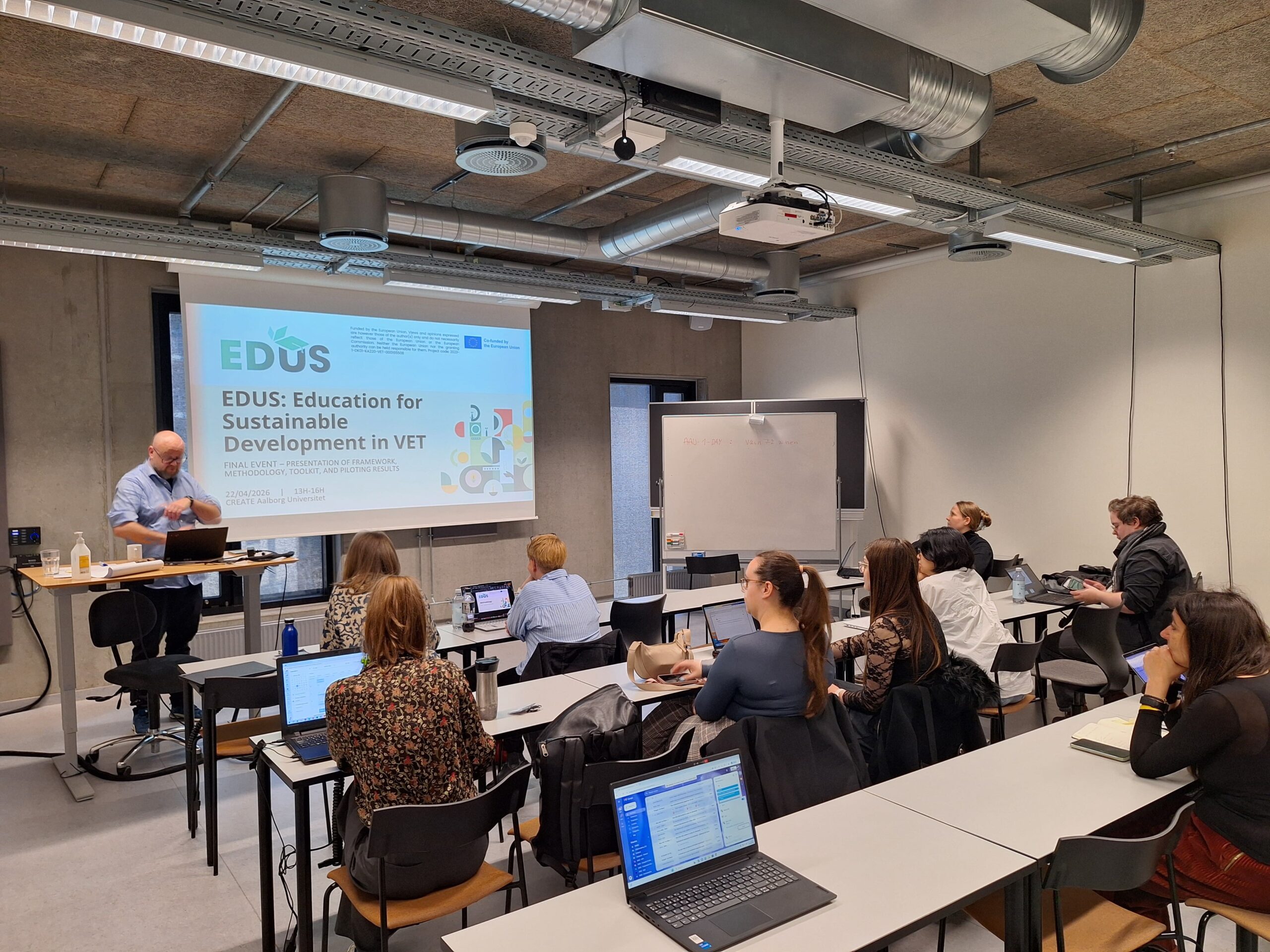
We identified that there are contradictions between the narratives of educational policy and the reality of schools. Can the EDUS framework be the tool we need to reveal these contradictions? Instead of merely describing the failures, can we use EDUS to make the invisible visible? If we can map these tensions using such a framework, perhaps we can move from diagnosing the problem to identifying pathways for genuine transformation.
Bibliography:
McGrath, S., & Ramsarup, P. (2024). Towards vocational education and training and skills development for sustainable futures. Journal of Vocational Education & Training, 76(2), 247–258. https://doi.org/10.1080/13636820.2024.2317574
Ramsarup, P., McGrath, S., & Lotz-Sisitka, H. (2024). A landscape view of emerging sustainability responses within VET. Journal of Vocational Education & Training, 76(2), 259– 280. https://doi.org/10.1080/13636820.2024.2320911
Weijzen, S. M. G., Onck, C., Wals, A. E., Tassone, V. C., & Kuijer-Siebelink, W. (2024). Vocational education for a sustainable future: Unveiling the collaborative learning narratives to make space for learning. Journal of Vocational Education & Training, 76(2), 331–353. https://doi.org/10.1080/13636820.2023.2270468