

Storytelling as a Tool for Teaching Sustainability
10/22/2025 admin
Written by Danijela Sitar
When we think of sustainability education, our minds often go straight to STEM fields like energy, engineering, climate science, technology… Yet, the transition toward a more sustainable future is not just a technical challenge. It is also a story about values, choices, cultures and communities. That is why storytelling is emerging as a powerful educational tool in sustainability learning, even (and especially) in non-technical disciplines.
Storytelling in the EDUS project
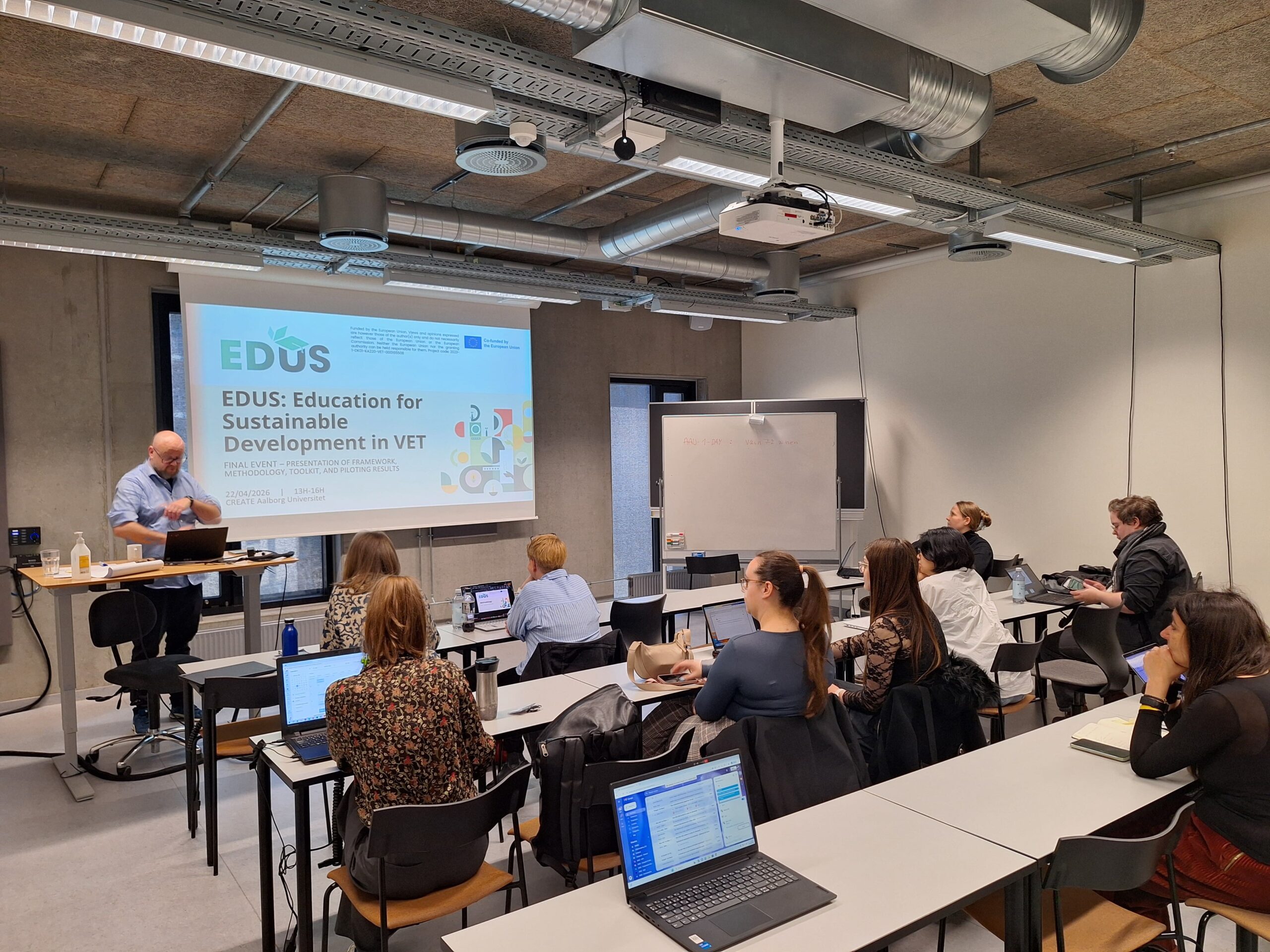
In the EDUS project we have explored storytelling in various ways. Some of the teachers involved in the EDUS VET piloting were not engineers or scientists, but language teachers — of English, Spanish and Slovenian. Their participation showed that the interest and need for sustainability learning extends beyond the STEM fields. It reaches into the humanities, languages and social sciences, areas where communication, reflection, creativity and values play a vital role.
Storytelling offers a natural bridge between these disciplines. It helps learners connect facts and emotions, data and meaning, individual experiences and global challenges. It is an approach which encourages empathy and engagement, both essential for understanding and acting on sustainability issues.
Within the EDUS project, storytelling also came to life through the EDUS Podcast (available on Spotify) where we’ve featured voices such as a blacksmith from Slovenia and a university professor from Spain. These conversations illustrate how storytelling can make sustainability tangible: a craftsperson reflecting on circular economy, or an educator reflecting on sustainable teaching practices.
What research says: Storytelling as a pedagogical tool
1. Making sustainability accessible and systems thinking friendly
Research by Maria Hofman-Bergholm (“Storytelling as an educational tool in sustainable education”, 2022) argues that storytelling can help make the complex idea of sustainability more accessible. It links storytelling with the development of systems-thinking and transformative learning that are crucial if we want learners not simply to know facts but to change their perspectives and behaviours.
2. Digital storytelling, global citizenship and sustainability awareness
Another study (Modi, Gupta 2024) on “Digital Storytelling as a Tool for Global Citizenship and Sustainability Awareness” emphasises how digital narratives (multimedia stories) enable students to engage with sustainability issues and cultural perspectives through storytelling.
For example, by weaving stories of global environmental challenges into a digital story format, educators helped students connect emotionally, reflect on values, and become more aware of sustainability as a global issue.
3. Storytelling combined with active, problem-based learning
A workshop-based study (d’Escoffier 2024) combined PBL with storytelling to teach sustainability to high school students. The findings suggest that while PBL improved knowledge, the storytelling component enhanced engagement, creativity and systemic thinking.
This underlines that storytelling works best when embedded into active, participative pedagogies.
Why this matters for non-STEM educators (humanistic and language educators)
Given these findings, there are clear implications for educators, especially those working in non-technical fields such as language teaching, the humanities, social sciences or arts:
- Storytelling allows learners to enter sustainability issues from a human, cultural and values-driven angle and not just from a technical or scientific viewpoint.
- Language teachers (for example) can integrate storytelling: e.g., asking learners to tell a story of a local sustainability challenge; or producing podcasts, short videos or narratives in the target language about sustainable living.
- Storytelling fosters reflection and meaning-making rather than only knowledge transmission. That way it supports the transformative dimension of sustainability education.
- Non-STEM educators are well-placed to lead this kind of work: they work with narrative, culture, communication, identity, all of which are central to sustainability.
Conclusion
Storytelling should not be seen only as a communication technique, but as a pedagogical tool that teachers, mentors and educators across all disciplines can use to foster sustainability awareness. Especially in language learning and the humanities, stories can inspire critical thinking, creativity and a sense of shared responsibility for the world we live in.
For the EDUS community (teachers in VET, mentors, educators…) the takeaway is clear: think about storytelling also in fields that are “non-technical.” Use it to open the door to sustainability from the human and cultural side. You can even hop on the EDUS Podcast, which already shares inspiring real-life stories from professionals and educators, as a teaching tool in the classroom. For example, to spark discussion, reflection, or creative language activities around sustainability themes.
At the same time, the EDUS Toolbox is designed to be flexible and adaptable across disciplines. Its resources and methods can be easily applied not only in technical or vocational subjects but also in humanistic and linguistic fields, encouraging teachers to connect sustainability with communication, culture, and storytelling. Teaching through stories extends beyond the transfer of knowledge; it fosters deeper understanding and motivates learners toward purposeful action.
References
Hofman-Bergholm, M. (2022). Storytelling as an educational tool in sustainable education. Sustainability, 14(5), 2946. https://doi.org/10.3390/su14052946
Modi, S., Gupta, T., & Rahmatullah, M. (2024). Digital storytelling as a tool for global citizenship and sustainability: Enhancing cross-cultural understanding in education. Journal of Interdisciplinary Studies in Education, 13(S1), 65-104. https://files.eric.ed.gov/fulltext/EJ1456191.pdf
d’Escoffier, A. H., Santiago, J. de O., & d’Escoffier, L. N. (2024). Stories that educate: Problem/project-based learning and storytelling in raising awareness for sustainability. Revista Electrónica de Enseñanza de las Ciencias, 24(2), 425-444. https://reec.uvigo.es/volumenes/volumen24/REEC_24_02_10_ex2287_1197.pdf